
 Article
What Is Turf in Football? Turf vs Cleats Explained
Two players can lace up equally good boots and still have completely different games on the same pitch. One cuts and accelerates without thinking about it. The other slips, hesitates, loses half a step on every turn. It's rarely about skill or even the price tag on the boots. Often it comes down to something simpler: what's actually under their feet.
That's where "turf" gets confusing. The word refers to an artificial grass surface, but it's also stamped on the side of football shoes built for exactly that surface. Mix the two up and you'll end up buying the wrong pair.
Turf shoes, firm-ground cleats and artificial-ground boots aren't interchangeable. Understanding why starts with the pitch, not the shoebox.
What Is Turf in Football?
Turf is synthetic grass — fibres standing in for the real thing. How it plays depends almost entirely on how it's built, not just what it looks like from the sideline.
Some pitches use short, tightly packed fibres over a hard base. Others go longer, with sand or rubber granules mixed in as infill. That difference changes everything about how a boot grips the ground.
You'll find artificial turf at five-a-side centres, training grounds, and most small-sided pitches, mainly because it holds up to heavy use without the upkeep grass needs. But don't assume all turf is the same. An older, compacted five-a-side cage can feel like concrete compared to a newer pitch with longer fibres and more cushion underfoot.
That's the whole reason footwear design matters here. A stud pattern built for soil behaves completely differently on synthetic fibres and rubber crumb.
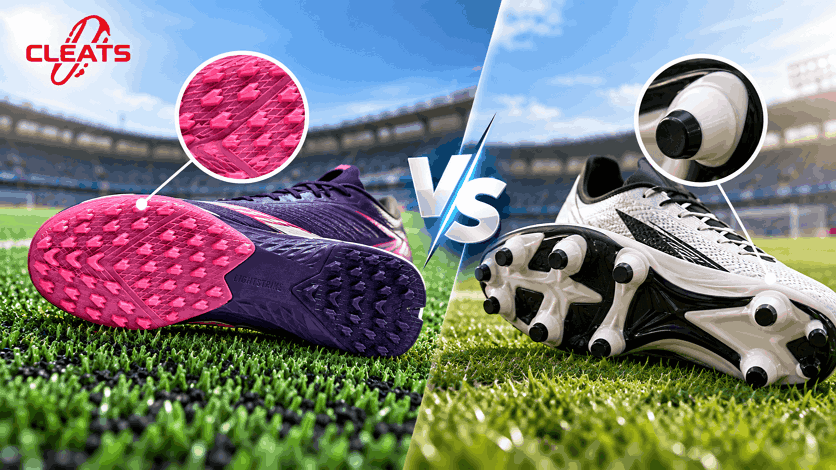
This is also where turf shoes come in — the ones with dozens of small rubber studs covering the sole. The idea is grip through contact points, not penetration.
Turf Shoes vs Cleats: Why the Outsole Matters
Turf shoes and cleats solve the same problem — grip — in opposite ways.
Turf shoes spread out dozens of short studs. Cleats use fewer, longer moulded studs meant to dig into real grass and soil. Neither wins outright. They're built for different ground.
| Feature | Turf Shoes (TF) | Firm-Ground Cleats (FG) |
|---|---|---|
| Stud design | Numerous short rubber studs | Longer moulded studs |
| Intended surface | Suitable artificial turf | Firm natural grass |
| Ground interaction | Multiple short contact points | Studs engage with the grass and underlying soil |
| Typical use | Small-sided turf football and suitable training surfaces | Outdoor football on natural grass |
| Main limitation | May lack sufficient grip on wet natural grass | May be uncomfortable or unsuitable on hard artificial surfaces |
Why Turf Shoes Work Differently
Put long studs on a hard artificial pitch and they won't sink in the way they're supposed to. Instead of grip, you get pressure points under your foot — not exactly comfortable through 90 minutes.
Turf shoes sidestep that by using a lot of small studs instead of a few long ones, spreading the load across the sole rather than concentrating it.
That doesn't make them automatically better, though. Stud material, pattern, how worn the pitch is, even how a player moves — all of that still matters more than the outsole label alone.
When Are Cleats the Better Choice?
On real grass, the ground itself does half the work. Moulded FG studs bite into firm soil, which is what lets a player plant a foot and actually change direction without sliding.
Wet, muddy fields are their own problem entirely — sometimes neither TF nor FG gets it right, and soft-ground (SG) boots with deeper studs make more sense.
The rule that actually holds up: match the shoe to the pitch you play on most, not the one in the highlight reel.
Types of Football Playing Surfaces
Not every shoe works on every surface, so it's worth knowing what you're actually standing on before buying anything.
Artificial Turf
Synthetic fibres, sometimes with sand or rubber infill mixed in. Firmness and fibre length vary a lot between facilities — a five-a-side cage downtown can feel nothing like a brand-new community pitch.
TF shoes generally suit these surfaces, but some venues have their own rules about what's allowed. Worth checking before you show up.
Natural Grass
Weather and upkeep change everything here. A dry, well-mowed pitch plays nothing like the same field after a week of rain.
FG boots are built for firm grass. SG boots handle the soft, wet stuff where studs need to dig in deeper.
Artificial Grass With Longer Fibres
Some synthetic pitches use longer fibres and heavier infill, which changes the feel underfoot compared to short, dense turf.
AG boots are made for these conditions specifically. Depending on the venue, a good TF shoe might still work — check the surface spec rather than guessing from the name.
Indoor Courts
Futsal and indoor five-a-side run on hard, smooth flooring, not grass at all. Traction here works completely differently.
Indoor shoes use flat rubber soles, often designed specifically not to scuff or mark the floor. Studded shoes — turf or otherwise — don't belong indoors.
What Do TF, FG, AG, SG and MG Mean?
These letters show up on every box, so it helps to actually know what they mean instead of guessing.
TF — Turf: Dozens of short rubber studs, built for suitable artificial turf and similar firm surfaces.
FG — Firm Ground: Longer moulded studs for firm or moderately firm natural grass.
AG — Artificial Ground: Built for specific artificial-grass pitches. Stud layout varies by model, so check it against your actual pitch.
SG — Soft Ground: Designed for soft, wet grass. Some use replaceable studs for deeper penetration when conditions call for it.
MG — Multi-Ground: Built to handle a few different surfaces reasonably well. Not a guarantee they'll excel on any single one.
TF and AG get confused constantly because both relate to artificial surfaces. They're not the same thing — different stud layout, different intended pitch. Check the manufacturer's guidance rather than assuming.
Three Turf Football Shoes to Explore at CleatsBD
Once you know your outsole category, it comes down to fit and personal preference. CleatsBD's turf collection includes a few standout options.
Turf F50 Messi Pro AG

A good option if you like the F50 line. It suits players on a suitable artificial surface. Check the fit and the product details before choosing it for regular turf sessions. Turf F50 Messi Pro AG
Turf Phantom Luna Elite 2026
The Phantom Luna Elite brings a different design to the turf selection. Like a more distinctive look? Compare it with other turf shoes. Base your choice on fit and the surface you normally play on. Turf Phantom Luna Elite 2026
Turf Tiempo Legend X Pearl Edition White
The Tiempo line suits players who want a more classic football-boot look. It's another turf option worth comparing. Check the current product details and available sizes before ordering. Turf Tiempo Legend X Pearl Edition White
TURF Mercurial Vapor 17 Elite
For players who prefer the Mercurial range, this turf model is worth a look. Compare the fit with other options in your size. Make sure the outsole matches your playing surface. TURF Mercurial Vapor 17 Elite
How to Choose Turf Shoes Without Buying the Wrong Pair
Break it down into three things: surface, fit, playing style.
Start With the Pitch
Mostly on small-sided artificial turf? TF is your starting point. Natural grass? Compare FG against SG depending on how wet it usually gets. Artificial grass with its own quirks? Check if the facility specifies AG.
Don't buy a shoe just because "turf" is in the name — confirm the actual outsole first.
Get the Fit Right
Your foot should sit snug, not squeezed. Too much room and your foot slides around inside the shoe. Too tight and you'll feel it by halftime.
Foot shape varies more than people expect — two players in the same size might need completely different models. Check the size chart before ordering online rather than guessing.
Consider How You Play
Playing style matters, but only after surface is sorted.
Quick, dribble-heavy players usually want a locked-in fit. Players grinding through long sessions tend to prioritize comfort over anything else.
Neither preference changes which outsole works on which pitch — surface comes first, feel comes second.
Think About Your Regular Playing Conditions
Playing the same turf pitch every week? One good pair of TF shoes probably covers you. Bouncing between grass, turf and indoor courts regularly? One pair won't cut it — plan for that instead of hoping a "universal" shoe solves it.
Can You Wear Turf Shoes on Natural Grass?
Technically, yes, on firm dry grass. But they're not a real substitute for grass-specific boots.
Short rubber studs just don't bite into soil the way FG studs do. On wet grass especially, that gap becomes obvious fast.
The reverse problem happens too — long FG studs on a hard artificial pitch don't sink in properly and can leave your foot sore by the end of a session.
Simplest approach: match the outsole to the surface you're actually playing on, not the one you wish you were.
Are Turf Shoes Suitable for Beginners?
If you're mostly on artificial turf, yes — TF shoes are a sensible, affordable starting point. No need to jump straight into pro-level boots.
What actually matters: does it fit the surface, does it fit your foot, is it comfortable moving around in. Price tag doesn't guarantee any of that.
And don't buy a shoe just because a pro wears it. What works for them on their pitch has nothing to do with what works for you on yours.
Frequently Asked Questions
What is turf in football?
Turf is usually an artificial grass surface. It's also the name for TF shoes — the ones with lots of short rubber studs built for that kind of pitch.
What is the difference between turf shoes and cleats?
Turf shoes use short rubber studs for artificial surfaces. FG cleats use longer moulded studs for firm natural grass. Pick based on where you actually play.
Are TF and AG football shoes the same?
No. TF uses many short studs. AG is built for specific artificial-grass setups with a different stud layout entirely. Check the manufacturer's guidance for your pitch.
Can I wear turf shoes on wet grass?
Not recommended. The short studs won't give you the grip you need on wet or muddy grass. Go with FG or SG depending on conditions.
Are turf shoes good for five-a-side football?
Generally yes, for artificial turf setups. Still worth checking the venue's rules — not every small-sided pitch uses the same type of turf.
Where can I buy turf football shoes in Bangladesh?
Check the CleatsBD Turf Collection for current sizes, pricing and product details.
The Right Shoes Start With the Right Surface
Understanding what each outsole is built for makes this whole decision easier. TF for artificial turf, FG for firm grass, SG for soft or wet ground. AG, MG and indoor shoes each cover their own specific case.
None of these categories is inherently "better" — the only question that matters is whether the shoe matches your pitch, fits your foot, and suits how you actually play.
If turf is where you spend most of your time, start with the Turf Football Shoes Collection at CleatsBD and compare from there.